
Learning to drive can open up new opportunities, but fitting weekly lessons around work, university or family commitments isn’t always straightforward. If you need your licence sooner rather than later, you may be wondering: can you learn to drive in a week?
The short answer is that you can make substantial progress in a week with an intensive driving course. Some learners, especially those with previous experience, may become ready for their practical test in that time. For complete beginners, however, a week of lessons may be the beginning of the journey rather than the end. Your progress matters more than the number of days on the calendar.
At The Best Intensive, we provide one-to-one intensive driving courses designed around different experience levels. Here’s what a week of lessons could involve, how many hours learners typically need and how to decide whether an intensive course is right for you.
Table of Contents - click to jump
Is It Really Possible to Learn to Drive in a Week?
Yes, although learning to operate a car and being ready to pass your practical test are not the same thing. A learner who has already mastered junctions, roundabouts and manoeuvres might use a week to improve consistency and prepare for a test. Someone who has never driven before will need time to learn vehicle control, develop road awareness and make safe decisions without prompting.
An intensive course brings lessons closer together. Instead of taking a two-hour lesson every week for ten weeks, for example, you could complete 20 hours across five days. This gives you regular opportunities to practise unfamiliar skills while they’re still fresh and means you don’t have to keep returning to them after long breaks.
There is no legal minimum number of driving lessons required before taking the practical test in Great Britain. The DVSA explains that readiness depends on being able to drive safely and independently. A fast course can help you develop those skills, but it isn’t a shortcut around them.
What Does a One Week Intensive Driving Course Look Like?
During an intensive driving course, you’ll typically spend several hours a day with your instructor rather than spreading those hours across months. The programme should reflect what you already know, the situations you find challenging and how well you’re progressing. At The Best Intensive, lessons are one-to-one, allowing your instructor to adjust the focus as your confidence grows.
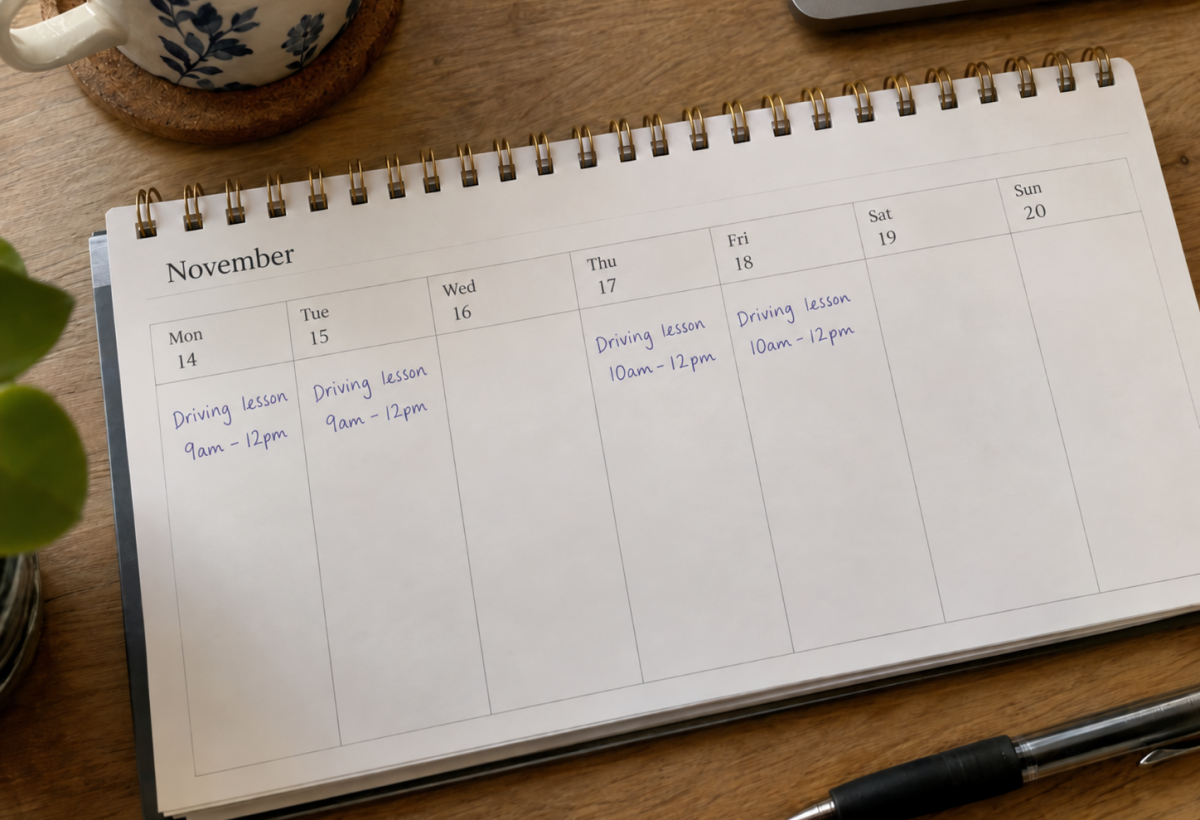
A five-day course could follow this broad pattern:
- Day 1: Get comfortable with the car, moving off, stopping, steering and, for manual learners, changing gears.
- Day 2: Practise road positioning, junctions, roundabouts and observing other road users.
- Day 3: Tackle busier roads, changing speed limits and more demanding traffic situations.
- Day 4: Build independent driving skills and practise reversing manoeuvres where appropriate.
- Day 5: Revisit weaker areas and, if you’re close to test standard, try a mock test.
This isn’t a fixed timetable or a promise that every learner will cover the same skills each day. Someone with experience may start with complex road situations, while a beginner could need longer on the fundamentals. The aim is to make progress without rushing past anything important.
How Many Hours Does It Usually Take to Learn to Drive?
There’s no single number that suits everyone. Some learners take naturally to controlling the car but need more practice judging hazards and traffic. Others become confident decision-makers once the basic controls feel familiar. That’s why choosing a course based only on how quickly you’d like to pass can be misleading.
Government research offers a helpful benchmark. In its 2026 consultation on a proposed minimum learning period, the Department for Transport cited studies in which newly qualified drivers reported averages of:
- 37 to 52 hours of professional driving lessons.
- 13 to 20 hours of additional practice with family or friends.
These are ranges of averages from different studies, not a requirement or prediction for an individual learner. You can read the source in the Department for Transport’s consultation.
What Do Those Figures Mean for a One Week Course?
Five hours of tuition a day for five days gives you 25 hours behind the wheel. That’s a meaningful amount of instruction, but still less than the professional tuition averages cited above. A learner who has already accumulated practice may find that enough to address remaining gaps; a complete beginner shouldn’t assume it will be enough to reach test standard.
Importantly, an intensive course changes when you learn, not necessarily how many hours you need. Its value is the concentrated timetable and continuity between lessons. A sensible course length should reflect your starting point, with room for further tuition if you need it.
Which Intensive Driving Course Is Right for You?
The Best Intensive offers courses of different lengths, so you don’t have to treat a one-week timetable as the only option. The following is a general guide, not a guarantee of test readiness:
Course | Typically suitable for | Usual duration |
10 hours | Experienced learners needing a refresher or focused test preparation | 3 to 4 days |
20 hours | Learners with some driving experience | 4 to 5 days |
25 hours | Learners who know the basics but need further practice | 5 to 7 days |
30 hours | Beginners or those with very limited experience | 7 to 10 days |
For example, a 10-hour course could suit someone who recently failed their practical test and needs to work on a few recurring faults. A learner who can control the car but lacks confidence at roundabouts might need more time, while a complete beginner will usually benefit from a broader programme that covers the foundations properly.
If you’re unsure which option fits, read our guide to choosing an intensive driving course or explore our available courses. Being clear about previous lessons, any test attempts and the areas you struggle with will help you choose realistically.
Can a Complete Beginner Learn to Drive in a Week?
A beginner can certainly start learning in a week and may develop their skills quickly through daily practice. But the first few lessons involve juggling a lot of new information: controlling the car, checking mirrors, identifying hazards, reading road signs and responding to other vehicles. Being able to perform each task with help is different from doing them all reliably while driving independently.
Intensive tuition offers the advantage of practising again the next day rather than waiting a week. Even so, several hours of concentration can be tiring, particularly when every situation is new. Breaks, realistic expectations and an adaptable teaching pace matter just as much as the total number of hours booked.
Our 30-hour course, typically spread over seven to ten days, is designed for beginners and learners with very limited experience. It provides more time to cover essential skills, although additional lessons may still be needed. Becoming a safe driver is a better goal than trying to meet an arbitrary seven-day deadline.
Intensive Courses or Weekly Lessons: Which Is Better?
Neither approach is automatically better for everyone. Weekly lessons can work well if you prefer shorter sessions, want time between lessons to absorb what you’ve learnt or can’t free up several days together. They also allow opportunities for private practice between sessions, where suitable supervision and insurance are in place.
An intensive course may suit you if you can dedicate a block of time to learning and prefer consistent practice. Spending consecutive days with the same instructor can make it easier to concentrate on areas that need attention without repeatedly revisiting the previous lesson. For someone juggling a new job or a move, completing the bulk of their tuition in one period may also be more convenient.
The trade-off is concentration. Driving for several hours a day requires focus, and rushing to finish a course can be counterproductive if you’re tired or overwhelmed. Choose the approach you can engage with safely, not simply the one with the shortest advertised duration.
Can You Pass Your Driving Test in the Same Week?
Possibly, but completing your lessons and securing a practical test appointment are separate challenges. You must pass your theory test before booking a practical driving test in Great Britain, and an appointment must be available when you’re genuinely ready.
Waiting times vary between test centres. The DVSA releases appointments up to 24 weeks ahead, and earlier dates can sometimes appear when other learners rearrange their bookings. That means even if you reach test standard after a week of intensive tuition, you may not be able to take your test immediately.
The Best Intensive offers a fast-track driving test service to help learners with test arrangements, subject to availability. Earlier appointments aren’t guaranteed, so it’s worth discussing your theory test status and preferred timetable before booking your course.
How Do You Know You're Ready for Your Practical Test?
A course ending doesn’t automatically mean you’re test-ready. You should be able to drive safely without regular prompts from your instructor, make sensible decisions in unfamiliar situations and stay aware of the people and vehicles around you. A mock test can be useful for identifying areas that still need attention.
Signs you’re approaching the required standard include:
- Handling junctions, roundabouts and different road types confidently.
- Checking mirrors and responding to hazards without reminders.
- Following signs and directions while making safe independent decisions.
- Completing reversing manoeuvres with effective observation and control.
- Driving consistently, not just getting individual manoeuvres right once.
Your practical test examines how you apply these skills in real traffic. If you’re unsure where you stand, our article on the seven signs you’re ready for your driving test explores this in more detail.
How Should You Prepare for an Intensive Course?
A little preparation can help you get more from each lesson. Before your course begins, make sure you have your provisional driving licence and tell us about any previous driving experience, even if it was a long time ago. This makes it easier to discuss an appropriate course length.
You can also start studying the Highway Code and practising hazard perception. You don’t need to pass your theory test before taking driving lessons, but understanding road signs and priorities can make practical tuition feel less overwhelming. The Best Intensive provides learners with access to online theory training materials, including Theory Test Pro.
Finally, leave time in your schedule to rest between sessions. Long days of driving can be demanding, and arriving focused will help you make better use of the hours you’ve booked.

Is a One Week Driving Course More Expensive?
An intensive course involves paying for several hours of tuition over a short period, so the upfront payment may be greater than the cost of one weekly lesson. That doesn’t necessarily mean the overall cost of learning will be higher or lower.
Your total spend depends mainly on how many hours you need, whether you can practise privately and whether you require further tuition before your test. Daily lessons may mean less time refreshing previous skills, but no course can promise that you’ll need fewer hours overall. For a fuller explanation of costs, see our guide to the cost of learning to drive in Norwich.
Why Choose The Best Intensive?
At The Best Intensive, we offer one-to-one intensive driving tuition in Norwich and Bristol, with manual and automatic options and course lengths for different levels of experience. Working with the same instructor throughout your course provides continuity, while our online theory resources can support your learning outside the car.
Whether you’re returning to lessons after a break or starting from scratch, the right course should help you progress towards safe, independent driving without unnecessary pressure. Explore our intensive driving courses to compare your options.
FAQs
Can you learn to drive in five days?
Some learners, especially those with previous experience, may become test-ready after five days of intensive tuition. A beginner may learn a great deal in that time but still need more hours before taking a practical test.
How many driving lessons do you need to pass?
There is no minimum number required by law in Great Britain. Department for Transport research cites average professional tuition figures ranging from 37 to 52 hours across different studies, although individual needs vary.
Can you take your theory and practical tests in the same week?
In principle, yes, but you must pass the theory test before booking the practical test. Finding an appointment in the same week may be difficult, even if you’re ready.
Are intensive driving courses suitable for nervous drivers?
They can be, provided the lesson pace and daily hours feel manageable. Discuss your confidence and concerns before choosing a course so you can select an approach that works for you.
Put Your Plans To Drive Into Motion
So, can you learn to drive in a week? You can make considerable progress, and some experienced learners may be ready for a practical test after several days. For others, especially complete beginners, taking longer is the sensible choice. What matters is feeling capable of driving safely on your own, not simply finishing a timetable.
At The Best Intensive, we’re here to help you find a course that matches your starting point. Take a look at our intensive driving courses or contact our team to discuss your next step.
Tagged driving course, driving lessons, learn to drive, Norwich